Fixed-price and time-and-materials contracts
Ordered, produced, invoiced, paid, and the margin at completion, whether the contract is fixed-price or time-and-materials.

pylotik brings together the operational reality of your contracts, projects, maintenance, teams and commitments: you see what is moving, what is blocked and what needs a decision, so you can answer your clients and anticipate drift. Your external clients get free access to their own space and validate online whatever concerns them.
Steering and reporting live in pylotik. Excel, PowerPoint and email are no longer the system of record for tracking commitments.
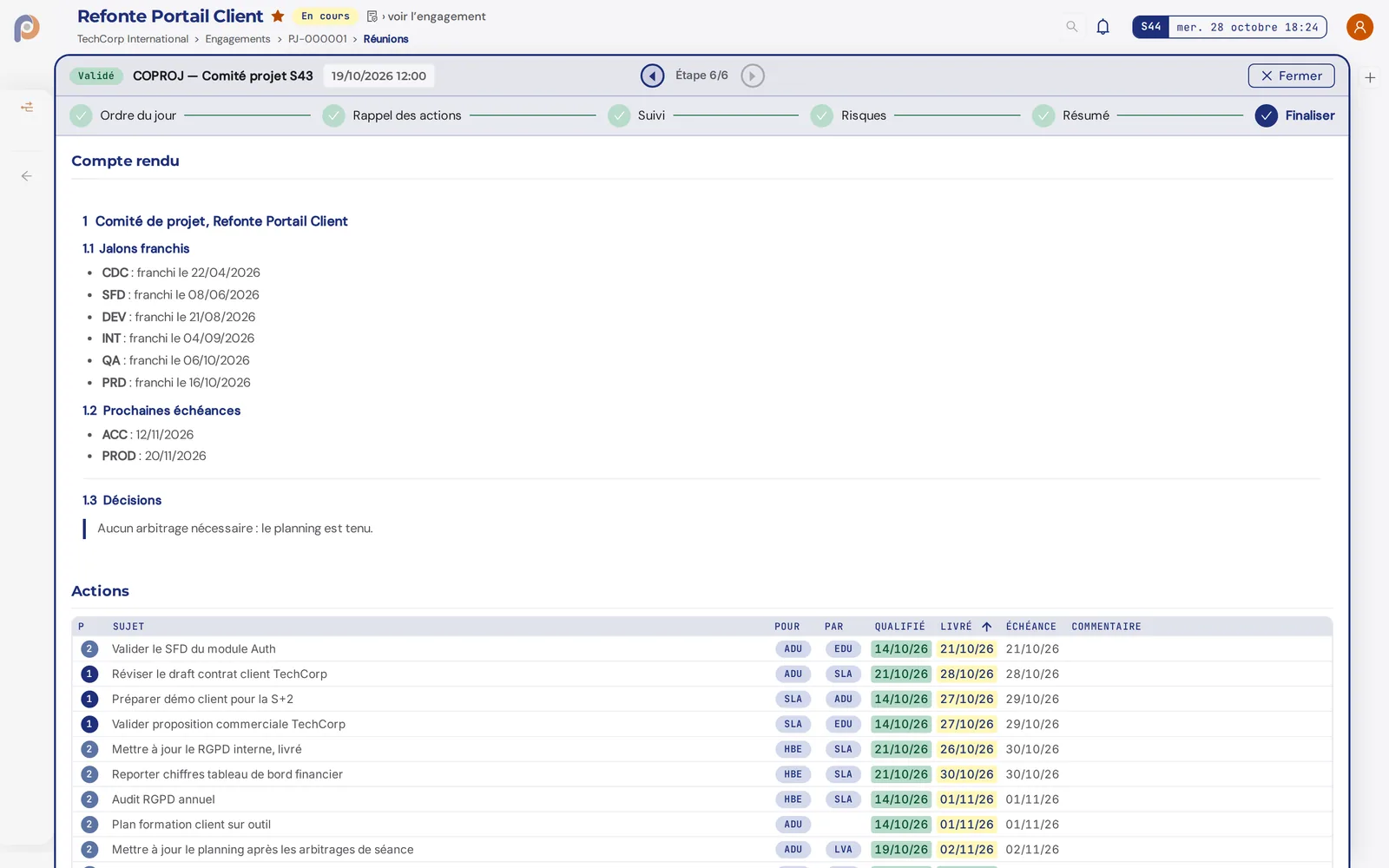
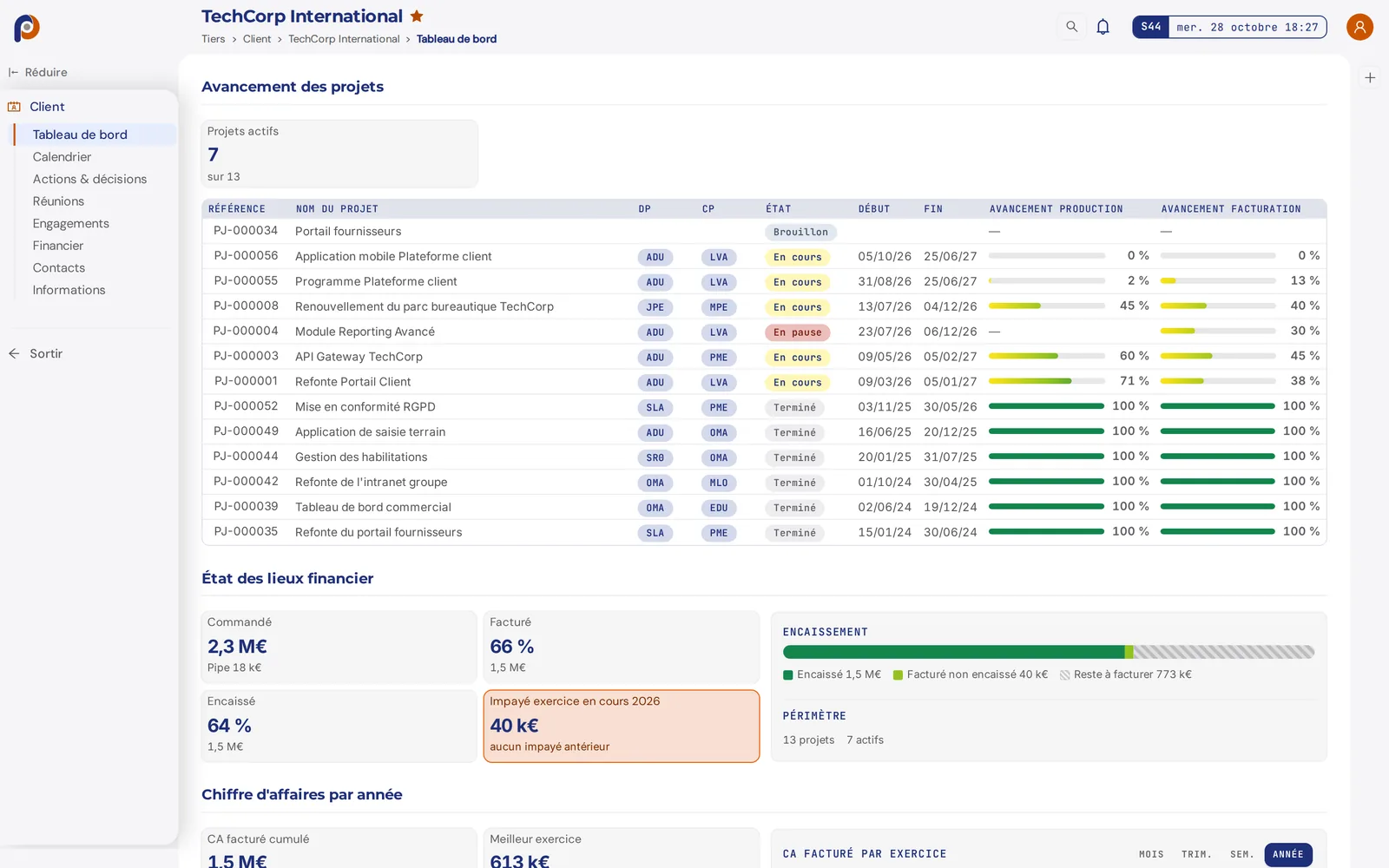
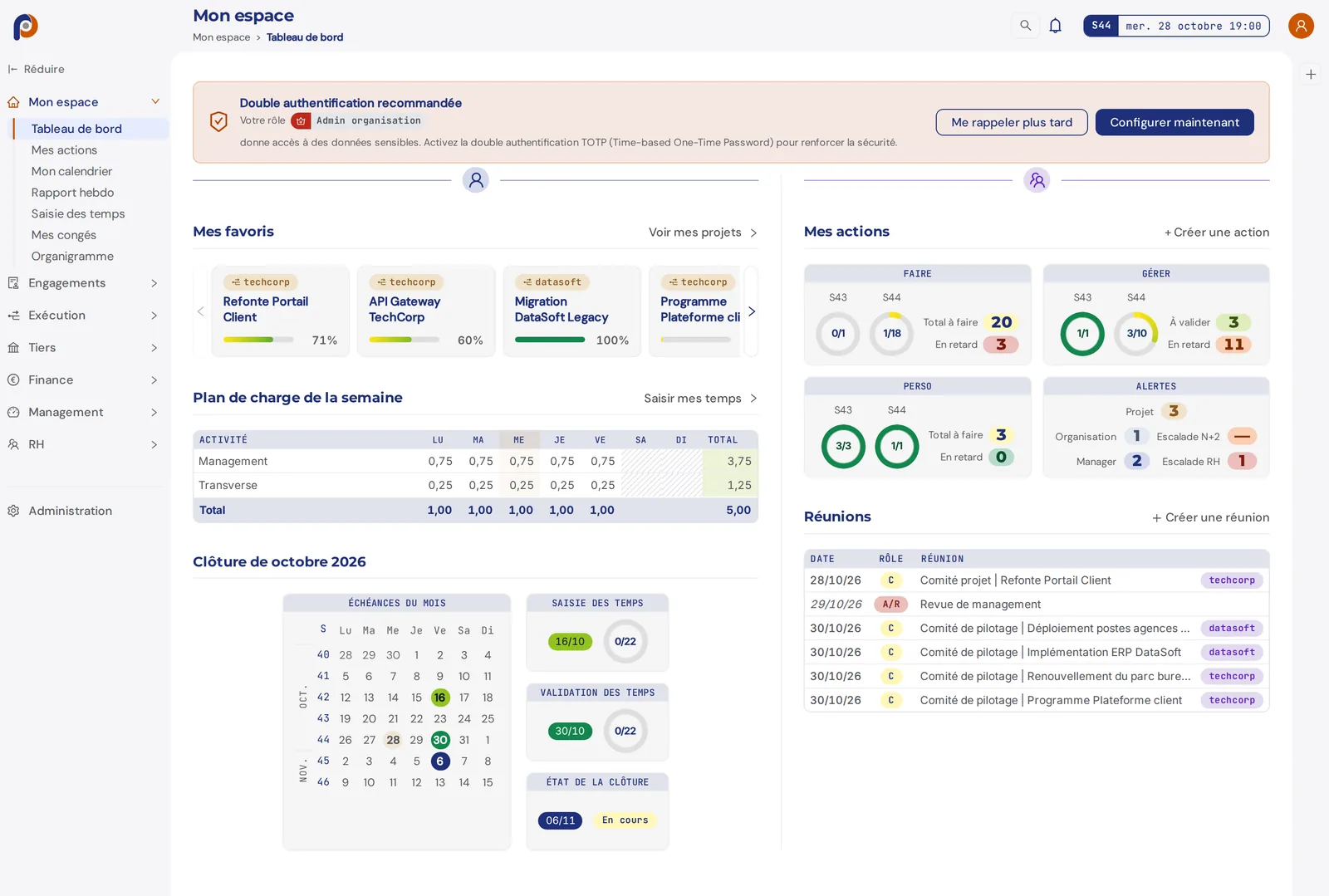
Here is what you see at a glance on this client's record: all its projects, their progress, what has been invoiced and what is still to collect. The record shows what the teams have entered, historized and dated: instead of rebuilding the information from each manager, you read it.
Reference, status, start and end dates, production and billing progress, project by project.
Ordered, invoiced, collected, overdue: where your relationship with them stands, and their revenue year by year.
Its rank and share of your business, according to your access rights.
From the same record: their calendar, their meetings, the actions and decisions under way.
What you see for one client, you see for your whole business, according to your rights. Everyone reads the same reality, each at their own level.
Your clients, your internal teams and your suppliers, each with its contracts and projects.
The projects you follow and the portfolio overview, with the status of each.
Billing tracking across all projects, in the same place as their progress.
Who is loaded, who has room, this week and over the coming months.
Project alerts and overdue actions, flagged to the people who must handle them.
The decisions and actions of each committee, attached to their project.
One tool for what used to be scattered across a task manager, a tracking spreadsheet, a shared calendar and email threads. The features marked as modules are added from the Business tier.
Ordered, produced, invoiced, paid, and the margin at completion, whether the contract is fixed-price or time-and-materials.
Projects, work packages, tasks and milestones, an overview of the portfolio and, with the Extended Project module, linked projects and tracked dependencies. Multi-project management →
Period, volume in days, catalog, committee and indicators shared with the client. Part of the core on every tier; a light module adds scheduling of interventions.
Your meetings and committees, in your own calendar, in the project's and in each client's or supplier's. Calendars →
Management and team steering: everyone's workload, time recorded by the week, the voice that rises, and the manager's review.
Your client follows progress, validates minutes and change orders, and never sees your margins. The client access →
No more PowerPoint or Excel to prepare: the meeting is held on the pylotik screens, its material is already there, and its agenda is followed point by point. Decisions, actions and risks attach to it, and the minutes go to the client for validation.
Time, actions, the Friday report and leave requests, on the phone. The mobile app →
Planned for December 2026: the pre-sales steering module, to coordinate the team against the clock, decide go or no-go, track results, and hand over to operations.
Three losses that seem separate and feed one another: a drifting project wears down the team carrying it, and a team that disengages eventually costs the client.
Only one project in three is delivered on time, on budget and with a satisfactory result. Drift shows as soon as it starts, when milestones, workload and margin live in the same place.
Standish Group, CHAOS 2020The share of a team's engagement that comes down to its manager. Everyone sees their workload, says what is stuck, to whom they choose, and is heard before it turns into a resignation.
Gallup, State of the Global Workplace 2026What it costs to acquire a client compared with keeping one. A client who follows the project and validates what concerns them in the tool no longer has to reconstruct it, or dispute it.
F. Reichheld (Bain), via Harvard Business ReviewTheir organization is invited by yours, free of charge, on every tier. They only see the projects and contracts that concern them.
Progress as validated at committee, milestones, the risks you share with them, meetings and their minutes, the financials of their project, the indicators of their contracts.
Committee minutes, which they validate, reject with a reason or send back for correction; change orders; the actions that fall to them, which they carry through to closure; and, where relevant, interventions, which they sign off or refuse.
Your margins, your costs, your teams' workload, your HR data, your internal milestones and actions, your internal reporting. They do not change your production data.
Email remains a working tool. It stops being the register where you search for who validated what, and when.
Meetings, decisions, actions, progress and reporting all happen in the tool, through the week: nobody rebuilds the steering by hand for the next committee. You do not reverse a downward spiral with goodwill, you reverse it with a mechanism.
Steering often fails for a mundane reason: keeping the tool up to date takes too much time. Data entry in pylotik was designed for a project manager's daily use, with the flexibility of a spreadsheet and the rigor of an audited database. What takes a few minutes to update stays up to date.
At regular intervals, pylotik freezes the state of every critical page: project, management, client relationship, finance, contract. These records are never rewritten. Three years later, a past week reads as it was lived, not as it is remembered.
Committees, decision logs, monthly reviews, contractual milestones: pylotik is the digitization of good steering practices, those of organizations assessed against frameworks such as CMMI, applied in the field for twenty-five years to structure, industrialize or turn around.
The requester, on the client side as on the supplier side, closes an action, never the assignee alone. An end to one-sided reporting: the delay of an action that falls to the client becomes as traceable as the supplier's.
What the manager observes and what team members live come up through two independent flows, which HR reads side by side on the same scope. Gaps become visible. HR moves from late referee to early sentinel.
No more steering or reporting files, spreadsheets or presentations, circulating by email, getting lost, with nobody settling the content. Steering and reporting rest on a single, central data set, and the running of the meeting itself takes place in the tool.
Commitment management says what was promised. It still has to be sustainable. That is the other half of the product, and a success factor before it is a function: a project does not only slip through its scope, it slips because the team disengaged before it did.
Every week, each person says where they stand, what struck them, and in what tone. It takes a few minutes, and it is not lost: what is said is read at two levels, by the manager and by the executive team.
What the manager says about the team and what the team says about itself cover the same scope and the same week. When the two accounts diverge, the gap becomes visible so it can be addressed, weeks before it becomes a resignation.
70% of engagement comes down to the manager: pylotik makes management something you steer, just like the project. A manager who does not hear is not a bad manager: most often, it is a manager without an instrument. The cycle that holds projects together gives them a regular reading of their team, with no extra meeting.
The stakes are not marginal: managers account for 70% of the variance in team engagement, and management practices weigh for nearly a third of the productivity variance between comparable companies. Worldwide, 22% of managers are engaged, against 79% in the best-run organizations.
SOURCE Gallup, State of the Global Workplace 2026 · Bloom, Sadun & Van Reenen, "Management as a technology?", NBER 2016.
The cause is never technical, never individual: it is organizational.
Fixed-price projects almost never slip all at once. They slip in silence, and the drift is discovered at invoicing, when it can no longer be recovered.
The diagnosis has been stable since 1994, and it is neither technological nor methodological: PMI documents near-identical performance across Waterfall, Agile and hybrid. What is missing is whatever makes drift visible while it can still be corrected.
Before pylotik, its founder spent twenty-five years turning projects around. One episode sums up the idea behind the tool: €200,000 of receivables stuck at an industrial-sector customer, unblocked in five minutes of a meeting, simply by sharing the factual reality of the project with the client.
The value was not lost: it was invisible, and therefore disputed. Making it visible was enough to recover it. pylotik turns that exceptional moment into a permanent way of working.
green for three months,
red in the boardroom this morning.

Each family was designed for one half of the problem, on the supplier side or the client side. In our July 2026 study of 44 European, American and general-purpose vendors, none combined project steering, contract steering and an open steering access for the client, in a single tool. What operational commitment management is →
| Family | Examples | What it does | What it does not carry |
|---|---|---|---|
| Work management | Asana, monday.com, ClickUp, Wrike, Trello | Organizes the tasks of a single organization. | Designed for one organization: the relationship with the client is not its subject. |
| PPM / SPM | Planisware, Planview, Sciforma, CESAR.TEAM | Steers a portfolio internal to the project office. | Designed for the project office, rarely open to the end client. |
| PSA | Kantata, Certinia, Deltek, Boond, Everwin, Stafiz | Optimizes the supplier's internal profitability. | Answers "am I profitable?", not "are my client and I talking about the same project?". |
| Project ticketing | Jira, Redmine, GitHub Issues | Tracks the requests and issues of a project. | Contractual milestones, committees and margin are not its subject. |
| ITSM | ServiceNow, GLPI, Jira Service Management | Handles incidents and service requests as they arrive, following ITIL. | A project's trajectory, its milestones and its committees with the client are not its subject. |
| ERP & HRIS | Sage, Cegid, Lucca, Eurécia, Workday | Handle the financial back end and internal HR. | Invoice what they are told; do not see the scope gap upstream. |
|
Operational commitment management | Carries the execution of contracts, projects and maintenance, and the keeping of commitments between client and supplier, on a single, historized data set. | Not project ticketing, not statutory invoicing, not payroll: it lives alongside these tools without replacing them, and optional connectors are built to the needs of clients. |
SOURCE Internal competitive study, July 2026, 44 vendors compared on 16 criteria covering governance, financial and human steering, and sovereignty. Positioning as declared by the vendors, not audited.
Project ticketing traces requests and issues. PSA steers a margin. PPM steers a portfolio. pylotik steers commitments, and the means to keep them.
Large organizations have a commitments office. You have pylotik. What operational commitment management is →
Without a tool that holds governance end to end, each team deploys its own Drive, its free Trello, its personal Notion. Project data lives everywhere and nowhere.
French data center, host under French law, data kept in the European Union. Neither the publisher nor its hosting providers have a US parent company, and that comes from their structure, not from a contractual clause.
With a second French provider, a direct lesson of the 2021 Strasbourg fire: the backup never sits with the primary host.
In 2025, Sciforma (Neuilly) came under Planview (Texas) and Forecast (Copenhagen) under Accelo (United States). An acquisition can move a customer under extraterritorial jurisdiction without their having decided it.
Not size, not sector, not legal status: industry, construction, engineering, digital, production, government or the public sector, Two conditions are enough: your organization is responsible for carrying out a service, a project, a contract or an intervention, and it has commitments to keep towards a client (a result, a deliverable, a milestone, a deadline, an intervention), whether written into the contract or only perceived as owed. Fixed price is the clearest case, not the only one, and the client can be another team in your company. Employing human time is not enough: what counts is responsibility for delivery. See where pylotik fits →
Modes where the supplier does not steer: pure staff augmentation and technical assistance, where the client directs people themselves, and continuous operations (managed services, outsourced IT) handled incident by incident. It is not the time spent that rules them out: a project or a maintenance contract billed on time and materials, which you steer, is within our ground. Their economics follow other rules. An organization with a mixed activity will find pylotik useful on its commitment-based projects, without having to equip its staff augmentation share.
pylotik replaces neither your project ticketing, nor your ERP, nor your invoicing tool: it connects to them, through connectors built to your needs: to Jira for technical work, to the ERP to send it billing orders. Your project task tools, however, it replaces: Trello, Asana or monday.com. Work packages, tasks and milestones live in pylotik, with a historized tracking shared with the client. Connectors are optional, available from the Business tier, and are built as needs arise.
Each client has its record. It brings together its projects with the production and billing progress of each, the financial position of the relationship (ordered, invoiced, collected, overdue), its revenue by year, its calendar, its meetings, its actions and its decisions. Its contracts are accessible from the same record. See the client portal for what the client sees itself.
The teams enter their work, pylotik historizes and dates it: milestones, actions, committee decisions, the consumed volume of a maintenance contract. You read the status when you open the record, without chasing each manager. This is not an automatic measurement: the status shown is the one that has been entered. See operational commitment management.
No. The ERP handles orders, stock and accounting, the CRM the commercial relationship, the CMMS the asset base and equipment, project ticketing the technical work, incident ticketing the incidents. pylotik manages the commitment made to the client and the teams that keep it, and can connect to these tools through a connector built to your needs. See the enterprise software landscape.
No. pylotik is used on its own, and orgatypik, which publishes it, also works with organizations that do not use it. One does not depend on the other. See the firm and the product.
Made visible, dated and shared, it becomes manageable again. Let's talk about your portfolio of commitment-based projects, and we will show you where it leaks in your case.